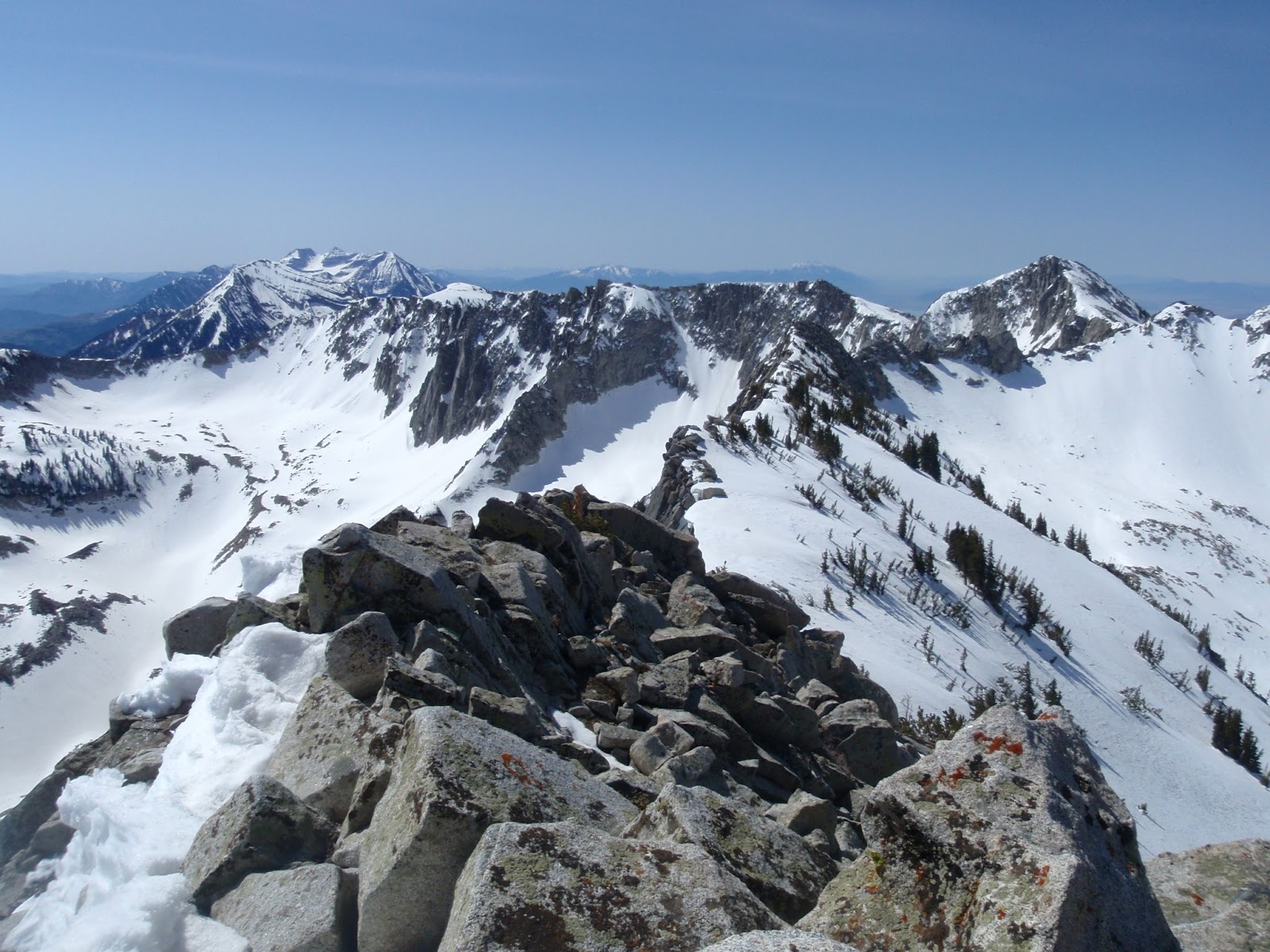
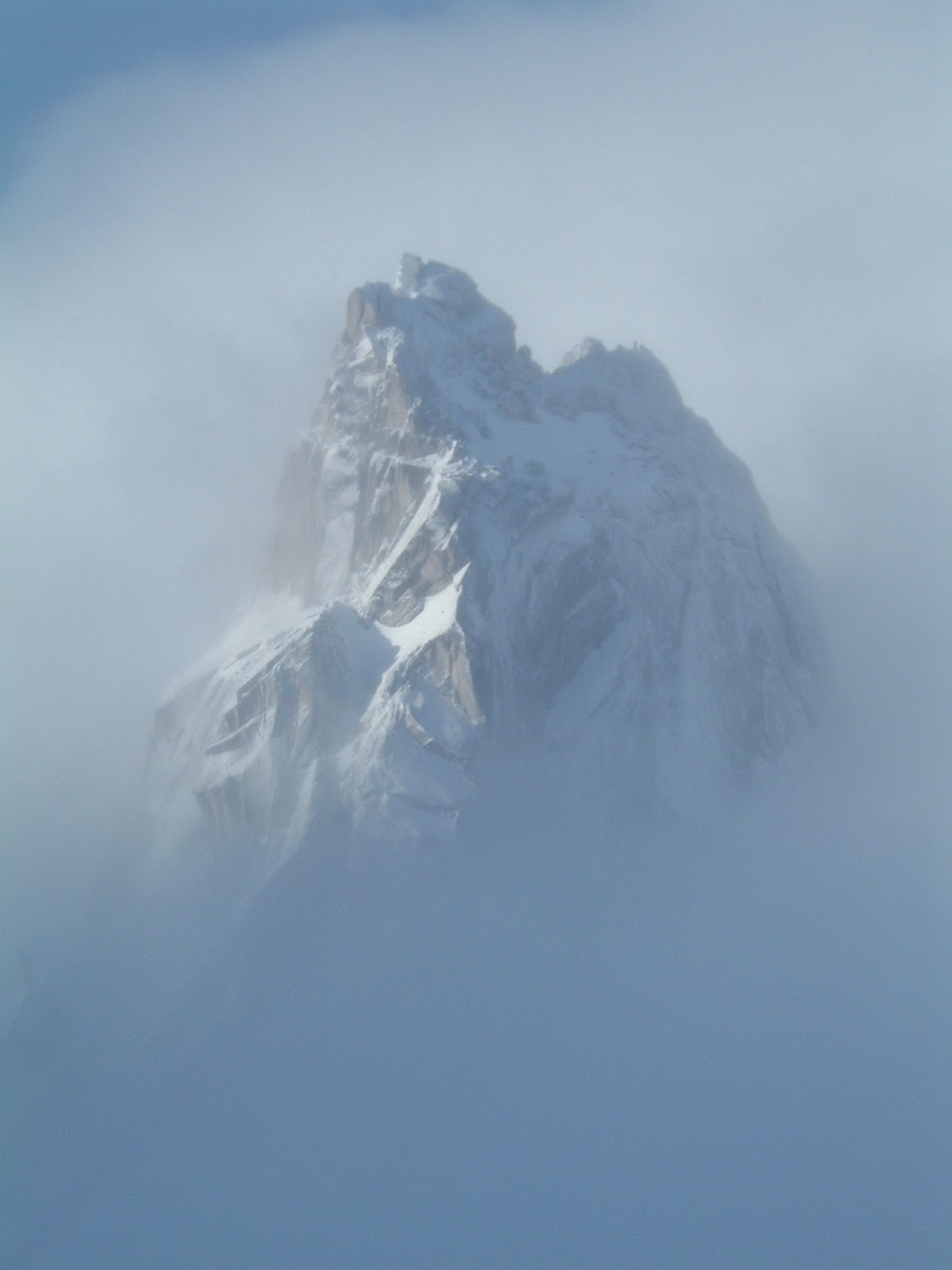
"I don't come to the mountains because the world is any better up here. I come into the high mountains because I am so much better up here. Down in the normal world I seldom have life under control. The details escape me. I muddle in confusion. Solutions are not apparent. A lead bar of stress sits in my gut and motivation is a struggle to summon. That stress is more debilitating than the fear I find here in the mountains, the cold alpine fear that impels me to hot rages of action. Here in the mountains I ride the limits of my human potential. I feel no doubt about the possible courses of action. I know what to do, how to do it, and I set about doing it. Here, I do not stomach compromise. I have become, like Jim, a goddamned, unrepentant alpinist, and our lives are victories, for we do not live like slaves."
A great book! If you think this quote makes absolute sense, then the book will be absolutely captivating.
http://www.goodreads.com/book/show/514674.Enduring_Patagonia
Wednesday, February 27, 2013
Monday, February 25, 2013
Vermin + Canyoneering = Good Fun
It was a few years ago when I was working at a Climbing gym, the Ben Lomond Climbing Center which was also my home away from home and the place where my extended family visited daily, that an idea was hatched to do a little canyoneering in Zion National Park, the mother of all canyoneering destinations. I had done a fair amount in the past so by default I was elected the trip organizer although my partners were equally as capable so that was a mere formality.
All things being considered the canyon went off without a hitch. We dropped into Pine Creek which was a rather moderate technical route but one that promised a purely spectacular experience. It was lean, dark, wet and cold with dizzying rappels amidst flying buttress style arches and chockstones and log jams to inchworm around. On the continuum of fun for canyoneers it ranked pretty high. That coupled with the fact that the first rappel was mere feet away from the bumper of ones car made it low hanging fruit. Perfect for our intentions.
Somehow on this adventure an unknown quantity was introduced into the group. Of the five people descending the canyon, myself and three others were patrons of BLCC and well known to me. One of my friends invited another individual who was a total novice to the vertical world which I wholeheartedly welcomed to the foray, generally enjoying the chance to share my passion with others.
Towards the end of the canyon my friend's friend had withstood most of the challenges quite well and I was duly impressed. On only a few occasions had she shed a tear or two before taking the plunge down one rappel and then another which was actually her only option given the nature of canyoneering. Once you start doing multiple rappels and pulling ropes you are basically committed to finish in the direction you are going.
She was a good sport for someone who knew not what she was getting into. The real challenge for her came later when we were enjoying a delicious spread prepared by our gracious hosts who were the parents of one of our group members. For me it was an unusually comfortable arrangement with free boarding inside a cozy house with thick slabs of bacon awaiting my hungry chops in the morning. For her it was another test of her tolerance for adventure in terms of her New York vegetarian idealism. Things got entertaining after one too many comments about eating meat for every meal when our host decided to share how a nuisance like a skunk is handled in Glendale, UT. Eradication included a 55 gallon drum full of water and a pirate inspired plank with a tempting morsel at the end of the line. If the design worked correctly, the critter would creep further along after its prize until the carefully weighted device gave way to physics and PLOP! Down went the the skunk, treading water for as long as it possibly could. The water served the dual purpose of finishing off the vermin as well as diluting the almost guaranteed stench it would create.
I suppose when you seek out adventure you are almost always in for more than you bargain. A healthy sense of humor goes a long ways and some flexibility too. It also never hurts to be considerate to the people you are imposing on.
http://www.canyoneeringusa.com/utah/zion/technical/pine-creek-canyon/
Thursday, February 21, 2013
The Grass Is Always Greener
![]() |
| Thunder Mountain, Red Canyon UT |
For those of you that have lived here for any amount of time, you might laugh at this but you are merely suffering from a case of "the-grass-is-always-greener syndrome." To prove my point I have one simple test. Pick up one of your favorite travel/adventure magazines and flip to the back. There you will find the ads trying to lure you to the most exotic places like Machu Picchu, Thailand, Mount Kilimanjaro, etc. And listed alongside all of those locations is Utah, not surprisingly.
![]() |
| Birch Hollow |
I realize that by definition "exotic" implies foreign or distant but just know that Utah, as a destination, is considered one of the most exotic places by everyone else in the world.
This doesn't stop me from wanting to buy a one way around the world ticket and take a year or two to see everything else. In the meantime though, Utah makes the ideal base camp.
Tuesday, February 19, 2013
And Now For Something Completely Different
It's a well developed and poignant idea. Thank you, Mr Cleese. It is worth committing the time to watch, or if you just can't bare it then skip to the soccer skit for a laugh.
Thursday, February 14, 2013
The Wasatch Scrambler
The following is a brief breakdown of ratings based on the Yosemite Decimal System (from wikipedia) up to the point when you begin subdividing what is traditionally considered roped climbing.
- Class 1: Walking with a low chance of injury.
- Class 2: Simple scrambling, with the possibility of occasional use of the hands. Little potential danger is encountered.
- Class 3: Scrambling with increased exposure. A rope can be carried but is usually not required. Falls are not always fatal.
- Class 4: Simple climbing, with exposure. A rope is often used. Natural protection can be easily found. Falls may well be fatal.
- Class 5: Technical free climbing involving rope, belaying, and other protection hardware for safety. Un-roped falls can result in severe injury or death.
Seems like a pretty straight forward explanation, that is until you tell people you went scrambling. Often the initiated climber looks at you rather strange. For many, a scramble is the unwanted portion needed to access the more desirable 5th class rock climb or it is an unfortunate low angle break in what would otherwise be a classic, 5-star route. For the non-rock climber it seems to mean you strayed off the hiking trail and up some dirty hillside.
| Looking south from North Thunder Mountain |
The degree of difficulty and the amount of risk you opt for is entirely your decision, as is the case with all climbing really. My only recommendation is to bring what you know and a healthy sense of adventure.
The following is a list of routes that I ticked off my list last year which I highly recommend. With the right attitude I think you will find them intrinsically enjoyable and great preparation for bigger goals.
- The Jagged Edge (5.4 ) - A very pleasant surprise in Ogden! Great position on the mountain and fun. The cruxy sections have good rock quality and are just spicy enough to keep it exciting.
- Geurts Ridge (5.5, II) - The west facing spine of Mount Olympus that keeps coming and coming with sections of exposure and the company of goats. It finishes on the South Summit . . .and then a knee rattling descent down the normal trail.
- Hypodermic Needle (Steep Snow, IV) - Off of North Thunder Mountain, this is one of the prized back country descents for skiers. Timing is everything to catch conditions right since it is not a rock scramble but rather a snow climb so crampons and axes may prove handy. I included it in the list because it embodied my overall goal. This is the most beautiful location I have visited in the Wasatch.
- South Ridge (5.4, II) - This is the prominent ridge on Mount Superior just across the street from Snowbird. It is another one desired by local ski mountaineers but in the summer it is a very pleasant scramble with sections of good exposure and access to several major summits.
- Mineral Slabs (5.2, II) - Beautiful, remote feeling within a stones throw of BCC road (literally). Remarkable low angle rock and stunning views. Our descent had something to be desired but that can be improved on.
A couple similar routes I did in the previous year:
- Stairs Gulch (Moderate Snow, IV) - Bring your best route finding instincts and a smile. We glissaded Bonkers into Broads Fork for the descent.
- Devils Castle Traverse (4th Class, II) - Setting is everything here. It almost makes you forget the chossy rock.
Rock climbing guide books often only briefly mention many of these options. The Internet provides the following useful resources.
Snapshot documentaries
A picture of Pigeon Spire I took while climbing the Kain Route on Bugaboo Spire. The Bugaboos are one of those truly amazing places in the world.
Tuesday, February 12, 2013
Riding the fence on wilderness B is giving me slivers
On the issue of "wilderness B," I am definitely on the fence, sort of, but not really.
I consider this a shameful place to be when I should be riding my bike instead of the fence. My attitude has never garnered me much favor among my mountain biking peers but that seems to be a general theme in my life so, what the hell.
For those who don't know about "wilderness B," it is a proposal to re-engineer or interpret the Wilderness Act of 1964 to accommodate bicycles. In 1964 mountain biking wasn't even a part of the conversation since it didn't really exist and therefore a debate has emerged about whether or not it is in accordance with, or in conflict with, the spirit of the law. As an avid mountain biker and outdoor enthusiast it begs the question about why I am on the fence and to that there is no simple answer.
Wilderness B advocates
I consider this a shameful place to be when I should be riding my bike instead of the fence. My attitude has never garnered me much favor among my mountain biking peers but that seems to be a general theme in my life so, what the hell.
For those who don't know about "wilderness B," it is a proposal to re-engineer or interpret the Wilderness Act of 1964 to accommodate bicycles. In 1964 mountain biking wasn't even a part of the conversation since it didn't really exist and therefore a debate has emerged about whether or not it is in accordance with, or in conflict with, the spirit of the law. As an avid mountain biker and outdoor enthusiast it begs the question about why I am on the fence and to that there is no simple answer.
![]() |
| East Fork Valley, Wind Rivers. Poorly digitized old film photos. |
Let me start with a basic explanation about why I support it. I don't think there is that much unresolvable conflict between current user groups and cyclists, they are often one in the same. There will always be purists who think otherwise. More importantly though is the idea that "wilderness needs no defense. It only needs more defenders" - I know, I know, again with the Abbey (he did provide the title for my blog after all). I think we are at a critical crossroad in the conservation/preservationist movement in this country and the "drill, baby, drill" mantra needs a little balance (and by that I mean a lot). A few more deep ecologists wouldn't hurt the conversation and in the bike community there are certainly a lot more fence sitters than just me. Why not tap that human resource?
On the other hand, does the introduction of bicycles into pristine wilderness qualitatively change it from being wilderness? This is where things get tricky. My personal view is yes and no. Biking is still a human powered activity, albeit mechanical. There is also a lot of evidence to support the idea that it is less damaging in terms of erosion than pack animals and even foot traffic by some accounts.
![]() |
| Steeple Peak 5.8, Deep Lake area. Classic climbing. |
So what is it that I oppose really? For me it has very little to do with the bike itself or the act of riding it, but rather the precedent. I am concerned about the slippery slope. If we allow bikes now, then what? And then after that what? I know a lot of mountain bikers who aren't happy riding through flat, uninspiring terrain to get to the beauty of a ride (hikers too for that matter). Wilderness can and should encapsulate greater ecosystems. Consider current trends. As more people recreate in the outdoors, roads become more prevalent, more are being paved, and then more extend deeper and deeper into the wild. In the hustle and bustle of modern life, will we shrink the distance needed to travel to get to the meat and potatoes of our outings? If so, this will compromise the notion of the ecosystem as a wilderness. Also by adding new "advocates" we might actually be increasing the number of proponents for quicker access to remote places rather than defenders of preservation, and if that happens we effectively undo the spirit of wilderness. I will cease examining the slippery slope short of asking who is next in line after the mountain bikers.
![]() |
| Erratic rocks near Wakashie Creek. |
In further defense of wilderness I can't help but point to one of my favorite destinations as an example, the Wind Rivers. These mountains embody my personal experience; expansive, remote, wild, unforgiving, and largely left untouched by modern technology. During my first visit there I recall driving several hours on paved roads followed by a lengthy spell of suspension testing, washboard dirt roads, and then a couple of days of arduous, although spectacular, backpacking before I reached my final destination. I felt distant and detached. It was wild. I even recall several years later going all the way around the world to Monte Fitz Roy in Argentina in search of that wild experience and thinking to myself how much more remote the East Fork Valley of the Wind Rivers felt. It is truly something unique and special.
So where does the bear shit in the woods in the Wind Rivers? Ultimately for me it is against "wilderness B." Sorry mountain biker friends but man never knows when to say when. Give him an inch and he'll take a mile. There aren't miles and miles of wilderness to give. Sure the "drill, baby, drill" folks will tell you otherwise, but in their view resources are practically endless. They are entitled to that perspective too as much as I am my own, but they also aren't going to be the people who truthfully labor through the difficult pros and cons of this debate. They have one view and one view only. I at least begrudgingly relinquish one of my favorite hobbies in favor of another, more deeply held belief. Sacrifice has to amount to something.
![]() |
| Looking over Haystack towards the Cirque of the Towers from the summit of Steeple Peak, 12,040'. |
Don't fret though my "wilderness B" supporter friends. I am all ears in this discussion if you can convince me that the slippery slope doesn't exist. Until then, I have to err on the side of caution. Maybe future wilderness designations deserve an entirely new consideration, one including "B" status ... but things do get mighty slippery, mighty fast, especially once one set of well intended folks move along and the entitlement of another group prevails.
About the Wilderness Act
Wilderness B advocates
Contiguous Ecosystems
Subscribe to:
Posts (Atom)